The Canadian mortgage broker software market has a clear shape. You have origination tools (Finmo, Filogix Expert, Velocity). You have CRMs (BluMortgage, Brokeredge, My Broker Pro). You have client engagement platforms (Ownwell). You have point-of-sale and document tools, AML vendors, lender search databases.
Missing from that list is a category that describes what BrokerPlus does: scanning an existing client book to surface deals the broker has missed. We call it mortgage revenue intelligence. The name matters because the job matters, and because no existing category quite describes it.
This post defines the category - what revenue intelligence is, how it differs from the tools brokers already use, and why it’s become relevant to Canadian brokers in 2026 in a way it wasn’t two years ago.
The category gap
Ask a mortgage broker what their CRM does. You’ll hear: “It manages my pipeline. Tracks active deals. Reminds me about renewals based on maturity dates I entered.”
Ask what their origination platform does. “It handles the application. Collects documents. Submits to the lender.”
Ask what their client engagement tool does. “It sends monthly reports to past clients so I stay top-of-mind.”
Now ask what surfaces the refinance opportunity the broker hasn’t noticed. The $400,000 mortgage where rates have dropped 150 basis points and the IRD penalty is small enough that the client should refinance. The HELOC-ready client whose home value jumped from $650K to $1.1M. The debt consolidation scenario where $40K of credit card debt makes a marginal refinance become a clear one.
None of the answers are the tools brokers already own. CRMs don’t scan your book for opportunities - they manage the opportunities you already know about. Origination platforms handle the deals in front of you, not the ones you haven’t found yet. Client engagement platforms keep you visible to past clients, but advisory-style reports are not the same as “this specific client has an actionable opportunity worth $4,700 of savings over the next year, here’s the penalty calc.”
That’s the gap. And the category that fills it is revenue intelligence.
What revenue intelligence actually does
A revenue intelligence platform scans the broker’s existing client database and identifies, across every client, which of five opportunity types applies at this moment:
- Refinance. Interest savings from switching to today’s rates exceed the penalty to break.
- Renewal. Inside or approaching the renewal window (zero to six months, or seven-plus months out).
- HELOC. Enough equity to qualify for a home equity line of credit.
- Reverse mortgage. Older client with significant equity who could benefit from accessing it without monthly repayments.
- Debt consolidation. High-interest unsecured or secured debt that could be rolled into a refinance, HELOC, or reverse mortgage.
For each opportunity, the platform calculates the specific dollar amount: how much the client saves, how much the broker earns, the net economics after penalties and fees. The math uses lender-specific IRD formulas rather than generic estimates, which matters because a penalty calculator that’s off by 20 percent gives the broker unreliable advice.
Then it prioritizes. Among the 300 clients in the book, which 15 are worth calling this month? Ranked by dollar value, not alphabetical order.
Then it automates outreach on the top candidates. Not advisory reports - actual emails from the broker’s own address, with customizable templates and follow-up logic, sent to the specific clients who have actionable opportunities right now.
That’s revenue intelligence. Scan, calculate, prioritize, reach out. Applied continuously so that as rates and home values move, the candidate list updates.
15-25%
of a typical Canadian broker's book has at least one actionable opportunity at any given moment. The job of revenue intelligence is to find them before they become invisible.
Why this is a distinct category
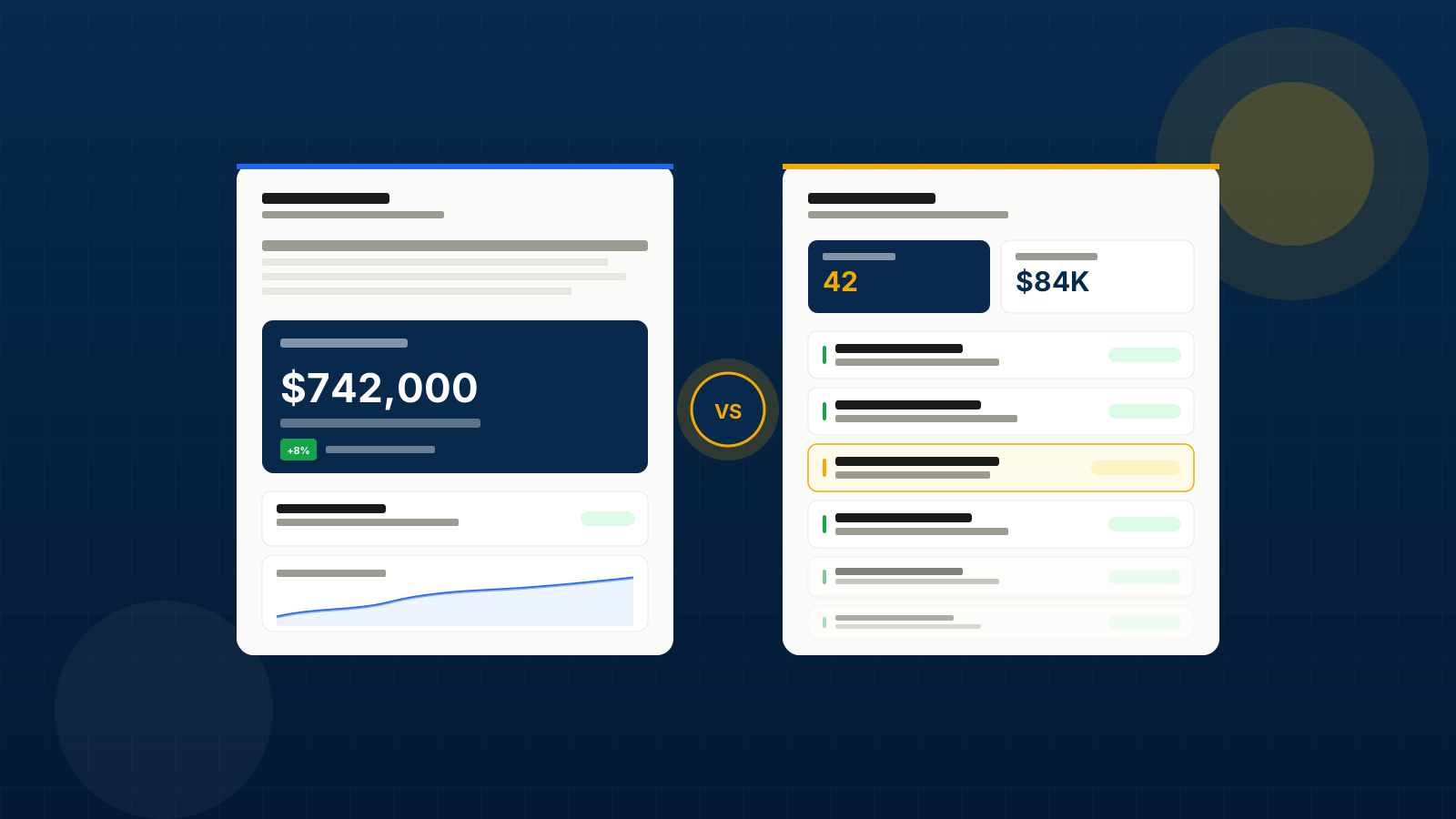
The temptation is to fold revenue intelligence under “CRM plus” or “smart CRM.” That framing is wrong because the jobs are genuinely different.
A CRM is about managing known opportunities. You enter a deal, track it through stages, coordinate with team members, follow up with the client on the timeline you set. The software helps you not lose track of what you already know.
Revenue intelligence is about surfacing unknown opportunities. You don’t know that client #247 is suddenly refinance-worthy because rates dropped two weeks ago. The software finds that for you, calculates the numbers, and tells you to call.
These require different data models, different analytics, different workflows. A CRM thinks in pipeline stages. Revenue intelligence thinks in opportunity types and dollar thresholds. A CRM alerts you when a client moves stages. Revenue intelligence alerts you when market conditions move in ways that change a client’s eligibility.
Client engagement is about relationship maintenance. You send polished homeowner reports so clients remember who you are between transactions. Advisory, not transactional.
Revenue intelligence is transactional. The output is “call this client this week because there’s $6,200 of net savings on the table and the penalty window closes when rates move.” That’s a different action than “the client received their monthly home value update.”
Same data inputs, different outputs. Different jobs.
Why this category is emerging in Canada in 2026
Three things changed in the last 24 months that made revenue intelligence a real category rather than a speculative idea.
Interest rate volatility created meaningful spread. The rate environment from 2022 to 2026 produced large gaps between clients’ contract rates and today’s rates. That spread is what makes refinance opportunities materially profitable, and it’s what makes systematic book scanning worth doing. In a flat-rate environment (like 2015-2019), spending time on refinance analysis was mostly wasted motion. Today it’s money on the table.
Home value appreciation created equity opportunities at scale. The average Canadian home gained significant value between 2020 and 2024, which created HELOC and reverse mortgage eligibility for clients who wouldn’t have qualified five years ago. Identifying those clients manually doesn’t scale; software does.
FINTRAC regulation created a data imperative. When Bill C-12 moved Canadian mortgage brokers into a heavier compliance regime in March 2026, the brokerages that had their client data centralized and current had an advantage. Brokerages whose client data was fragmented across spreadsheets, old Filogix exports, and incomplete CRMs faced real operational risk. Revenue intelligence platforms, because they require a centralized imported book to function, incidentally solve the “where is our client data actually” problem as a side effect.
Three market conditions converging. That’s how categories emerge.
What revenue intelligence isn’t
Worth being clear on what this category doesn’t do, because vendor marketing muddles these lines regularly.
It’s not a CRM. It doesn’t manage active deal pipeline, team tasks, or in-flight transactions. Brokers using a revenue intelligence platform still need a CRM for day-to-day deal management.
It’s not an origination platform. It doesn’t capture applications, collect documents, or submit to lenders. You still need Finmo or equivalent.
It’s not a client engagement platform. It can send outreach, but the purpose is to drive transactions on identified opportunities, not to maintain advisory touch with every client monthly.
It’s not AML screening, on its own. Though some revenue intelligence platforms (BrokerPlus being one example) integrate AML and FINTRAC screening because both processes require the same imported client database and the same per-client operations. The integration is efficient but the category itself is defined by revenue discovery, not compliance.
A complete 2026 broker tech stack typically includes: origination (Finmo) + CRM (BluMortgage or similar) + revenue intelligence (BrokerPlus) + client engagement (Ownwell, optional). Each solves a distinct problem.
How to evaluate a revenue intelligence platform
If you’re considering tools in this category, the questions that actually matter:
Does it calculate lender-specific IRD, or generic estimates? The difference is thousands of dollars per client. Generic estimates are fine for consumer tools; they’re inadequate for brokers giving professional advice.
Does it update continuously, or only on import? A book scan run once a quarter misses the opportunities that opened up last week. The value compounds with update frequency.
Does it handle all five opportunity types, or just some? A platform that flags refinance opportunities but ignores HELOC, reverse mortgage, and consolidation leaves revenue unseen.
Does it automate outreach, or just report? Identifying opportunities doesn’t produce revenue. Contacting clients about them does. A platform that stops at reporting puts the execution burden back on the broker and loses most of the value.
Does the outreach use your brand, or the vendor’s? Branded outreach from the broker’s own email address converts meaningfully better than tool-branded emails and preserves the broker’s client relationship.
What’s the pricing model at scale? Per-client pricing gets expensive as your book grows. Flat pricing is predictable. The right answer depends on your book size and expected growth.
Where BrokerPlus fits
BrokerPlus is the revenue intelligence platform we build. V1 handles all five opportunity types with lender-specific IRD math. It updates continuously. Outreach automation is built in, branded to the broker, with follow-up logic. FINTRAC and AML screening is integrated because the data model already supports it. Pricing is flat at $99 CAD per month regardless of book size.
We didn’t invent the job. Brokers have been trying to do this manually for years, with spreadsheets and calendars and memory. What’s changed is that the combination of rate volatility, home value appreciation, regulatory pressure, and mature broker data systems made a software category viable. We’re the first Canadian product built entirely around this job, and we think more will follow.
If the category catches on the way we expect it to, “mortgage revenue intelligence” will be standard vocabulary in broker tech-stack conversations by 2027. You read it here first.
Frequently asked questions
Is mortgage revenue intelligence different from “smart CRM” features?
Yes. Some CRMs (including BluMortgage) have started adding reporting features that surface refinance or renewal candidates. Those are incremental additions to a CRM product, typically using simpler math and a narrower opportunity definition. A purpose-built revenue intelligence platform goes deeper on the math (lender-specific IRD), wider on opportunity types (all five, not just refinance and renewal), and handles the outreach execution layer that CRMs don’t touch. They’re distinct categories even where the features overlap.
Do I need revenue intelligence if I’m already using Ownwell?
Ownwell is a client engagement platform that surfaces some equity and rate opportunities as part of monthly homeowner reports. For brokers whose primary need is staying in front of clients and whose math tolerance is “approximate,” Ownwell is sufficient. For brokers who need lender-specific IRD precision, debt consolidation scenario analysis, or transactional outreach with follow-up logic, revenue intelligence is a different tool. Some brokers use both.
How much of a book does this actually surface?
The benchmark we’ve seen across Canadian brokerages using BrokerPlus is 15 to 25 percent of the book will have at least one actionable opportunity at any given time. Books weighted toward clients who funded 3+ years ago produce the highest opportunity density because those clients are more likely to be in a renewal window or have meaningful equity accumulation.
Is this the same thing as “upselling” my book?
Not quite. Upselling implies pushing a client into a product they don’t need. Revenue intelligence identifies opportunities where the math actually works in the client’s favour - refinance savings net of penalties, consolidation scenarios that reduce total interest, HELOC eligibility the client could genuinely use. The software surfaces candidates; the broker’s professional judgment determines whether the specific opportunity fits the specific client. Done well, it’s the opposite of high-pressure sales - it’s the broker being proactively useful with evidence.
How does revenue intelligence interact with FINTRAC compliance?
The two jobs share the same data model: both require a centralized, current database of every client the broker has ever worked with. A platform that handles revenue intelligence is usually well-positioned to handle AML screening too, because the client records already exist. BrokerPlus integrates both. Other approaches (separate tools for each) can work but duplicate the data-management overhead.
What’s the learning curve?
For the broker, minimal. Import your book from Filogix, Velocity, Finmo, or CSV. The scan runs automatically. Opportunities appear ranked by dollar value. The main learning is understanding what thresholds to set for your own preferences (minimum net savings to flag a refinance, minimum available HELOC to flag an equity opportunity, etc.). Most brokers configure this in an hour and then let the platform run continuously.
Will this category get more crowded?
Almost certainly. We expect at least two or three additional Canadian platforms to position themselves as revenue intelligence tools over the next 18 to 24 months, either new entrants or existing CRMs adding the feature set. That’s healthy - it validates the category. The brokers evaluating in that market will have to look past the category label to the actual mechanics: IRD methodology, opportunity coverage, outreach automation, pricing at scale.