Most Canadian mortgage brokers talk about debt consolidation as an occasional use case - a conversation they have with a client who happens to mention they’re struggling with credit cards. They rarely treat it as a systematic revenue category worth scanning the book for.
That’s a mistake. Debt consolidation is one of the most profitable conversations in a broker’s repertoire. The math is clear, the client benefit is large, and the consolidation overlay turns marginal refinance, HELOC, and reverse mortgage scenarios into clear ones. A broker who systematically runs consolidation analysis across their book surfaces deals that would otherwise stay invisible.
This post is the playbook. How consolidation math actually works, which debts to include, how to present the analysis to clients, and how consolidation fits alongside refinance, HELOC, and reverse mortgage scenarios.
Why consolidation is underused
Canadian mortgage brokers tend to think in mortgage categories - refinance, renewal, HELOC, reverse mortgage. Consumer debt lives in a different mental bucket. Credit card interest rates, car loan balances, personal lines of credit feel like “the client’s other problems” rather than broker opportunities.
The blind spot is that every one of those debts is refinanceable through a mortgage-secured product. And because mortgage rates in Canada are typically 15 to 20 percentage points lower than credit card rates, the math heavily favours consolidation whenever the client has enough equity to support it.
The brokers who systematically ask “what other debt does this client carry?” routinely find consolidation opportunities that turn $200,000 of client interest savings over the life of the debt into funded mortgage deals. The brokers who don’t ask leave that money on the table.
The blended rate formula
The core math of debt consolidation:
Blended rate = (Sum of each debt × its rate) ÷ Total debt
This gives you the weighted average interest rate across the client’s current debt. The comparison to the proposed mortgage rate tells you the spread - and the spread is what drives the savings.
Example:
| Debt |
Balance |
Rate |
Interest-weighted |
| Mortgage |
$400,000 |
4.5% |
$18,000 |
| Credit card |
$25,000 |
20.0% |
$5,000 |
| Car loan |
$15,000 |
8.0% |
$1,200 |
| Line of credit |
$10,000 |
9.5% |
$950 |
| Total |
$450,000 |
|
$25,150 |
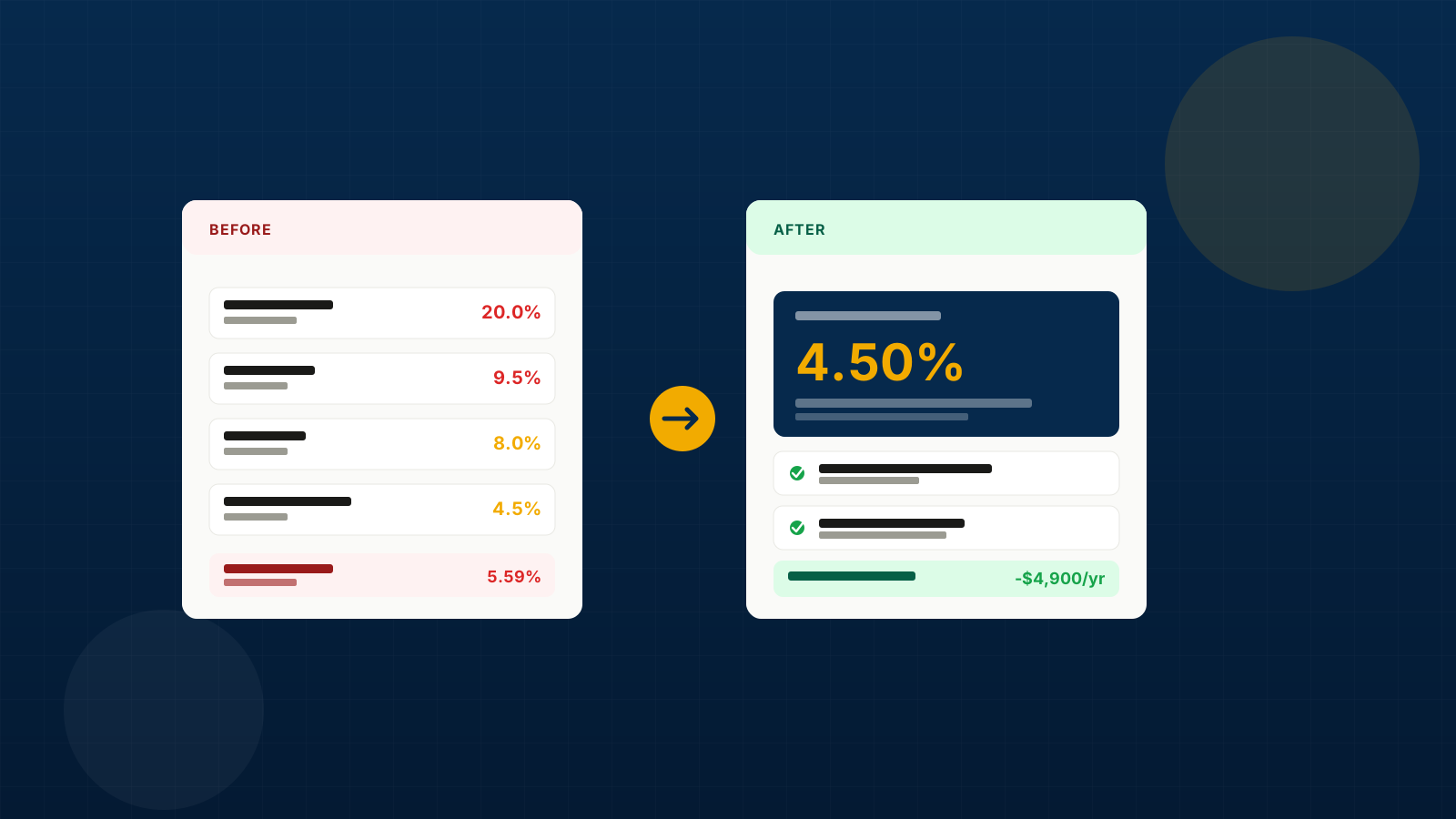
Current blended rate: $25,150 ÷ $450,000 = 5.59%.
If the client refinances everything into a new mortgage at 4.5%, the annual interest cost drops from $25,150 to $20,250 - saving roughly $4,900 per year in interest.
$4,900/yr
typical annual interest savings for a Canadian client consolidating $50K of consumer debt into a mortgage-secured product. Scale up or down based on actual debt levels; the math is linear.
Multiply that over the life of the debt and the savings are substantial. The specific annual number is what you show the client.
Which debts to include in the analysis
Not all debt is consolidatable; not all consolidatable debt should be consolidated. The rough hierarchy:
Always include:
- Credit card balances. Highest interest rates (typically 18-22 percent), no tax treatment benefits, always worth consolidating when the client has equity.
- Unsecured personal lines of credit. Usually 7-10 percent, still meaningfully higher than mortgage rates.
- Unsecured personal loans. Variable depending on source but usually refinanceable.
Usually include:
- Car loans. Rates 5-10 percent depending on age of loan and credit. The consolidation math works but the term structure (typically 5-7 years for auto) is shorter than a mortgage amortization. Worth evaluating; usually includes.
- Secured lines of credit (non-HELOC). Varies; include based on rate and client preference.
Sometimes include:
- Student loans (Canadian federal/provincial). These have favourable rates and tax treatment. Usually don’t consolidate these; they stay put.
- Business debt. Different tax treatment. Consult with the client’s accountant before including in personal-scenario analysis.
- Tax debt (CRA). CRA has payment arrangement programs. Often better to resolve through those than consolidate into a mortgage. Evaluate case-by-case.
Never include:
- Secured debt at favourable rates the client wants to keep separate (e.g., a low-rate vehicle lease).
- Debt under specific rehabilitation or bankruptcy arrangements. Disrupting these can hurt the client legally; stay out.
For most Canadian clients, the consolidation universe is credit cards + unsecured lines of credit + maybe car loan. That’s usually where the majority of the savings opportunity sits.
The three consolidation structures
Depending on the client’s mortgage situation, consolidation can happen through one of three vehicles:
Refinance consolidation
The client breaks their current mortgage (paying the IRD or three-months’-interest penalty) and takes a new mortgage that includes the consolidated debts.
Best for: clients where the refinance math works on its own even before consolidation, and where adding the consolidation makes it materially better. Also clients whose current mortgage rate is substantially above market rates.
Math to run: (new mortgage payment after consolidation) vs (current mortgage payment + all debt service costs). The savings number is the difference.
HELOC consolidation
The client keeps their current mortgage as-is and takes out a HELOC to pay off the consumer debt.
Best for: clients whose current mortgage is at a good rate they don’t want to break, or clients whose current mortgage term has substantial time remaining with a large IRD penalty. The HELOC absorbs the consumer debt without disrupting the main mortgage.
Math to run: (HELOC interest on consolidated amount) vs (sum of consumer debt interest at current rates). The savings number is the difference. Note: HELOCs are usually variable-rate, so factor in rate exposure.
Reverse mortgage consolidation
The client (typically 55+) uses a reverse mortgage to consolidate debts without monthly payments.
Best for: older clients who want to eliminate debt payments entirely as part of retirement cash flow planning. Less about headline interest savings and more about eliminating monthly obligations.
Math to run: Less about annual interest comparison and more about the client’s cash flow. The reverse mortgage eliminates monthly debt service entirely, freeing up that cash for other uses.
Running consolidation as an overlay
The systematic approach is to run consolidation as an overlay on every refinance, HELOC, and reverse mortgage candidate in your book.
For every candidate identified in your revenue intelligence scan:
- Pull the client’s known debt data (credit file access, any debts noted in their original application, any updates the client has provided via interactive reports).
- Run both scenarios: the mortgage opportunity without consolidation, and the mortgage opportunity with consolidation.
- Compare the two numbers.
- Rank candidates by the combined (mortgage savings + consolidation savings).
This is what BrokerPlus does automatically. Any refinance, HELOC, or reverse mortgage opportunity gets a consolidation overlay calculated at the same time as the base scenario. Clients where the overlay substantially changes the math get flagged specifically as “consolidation-strong” candidates.
Presenting consolidation to the client
The consolidation conversation works best when the client can see the total picture. Three numbers they need to understand:
Current state. Their current monthly debt service across mortgage + consumer debts. Their blended interest rate. Total annual interest cost.
Consolidated state. New monthly payment under the consolidation scenario. New blended rate (now effectively the mortgage rate). New annual interest cost.
The savings. Difference in annual interest, difference in monthly cash flow, total savings over the planning horizon.
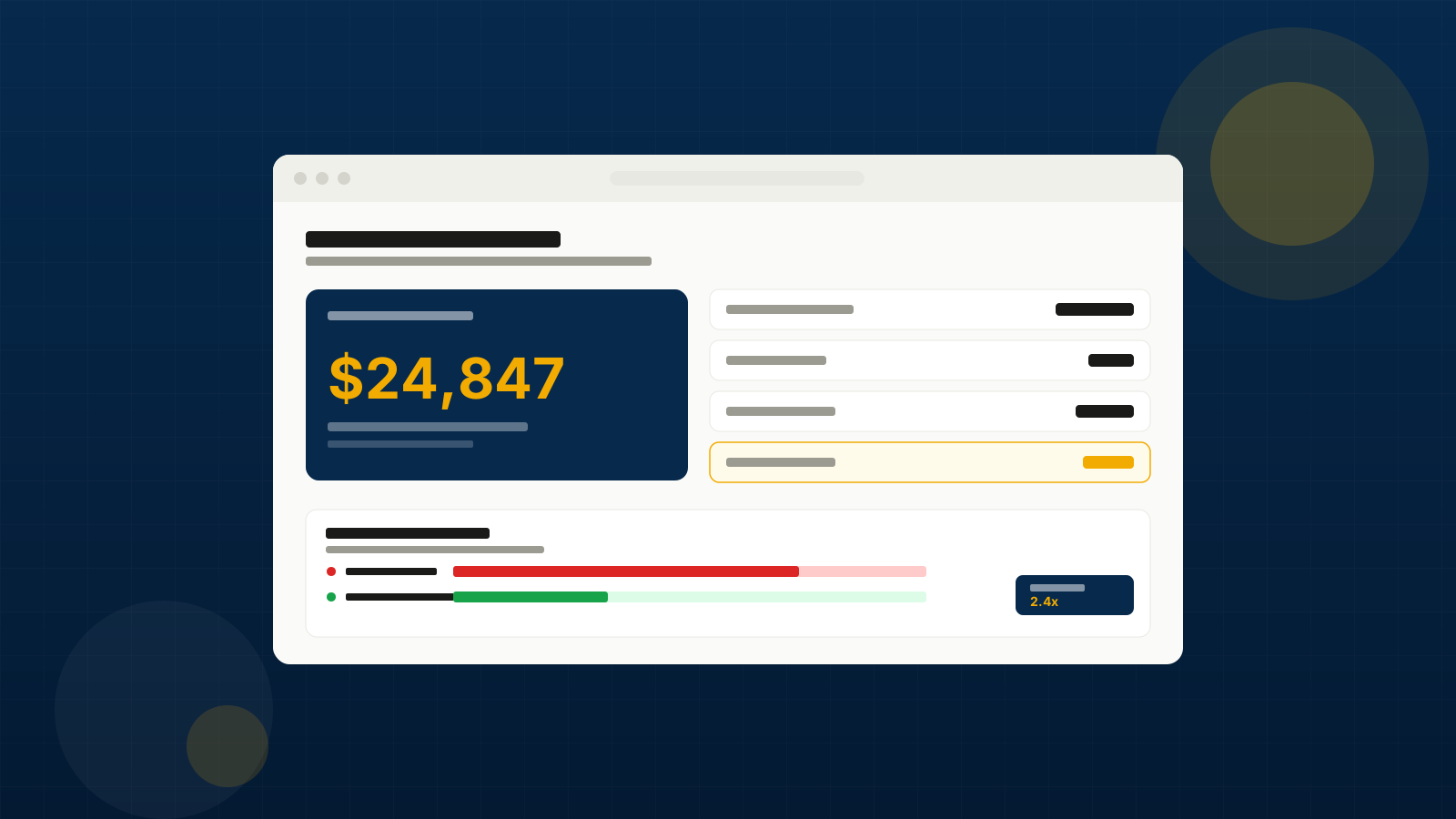
A branded consolidation report that shows these three states side by side is more persuasive than a verbal walk-through. BrokerPlus generates this report automatically with the client’s name, the broker’s branding, and the specific numbers for their scenario.
One framing note: the consolidation conversation should be about total financial outcome, not just interest rate. Some clients will be more responsive to “you’ll save $6,000 per year” than to “your rate drops from 5.6% to 4.5%.” Both are true; pick the framing the specific client responds to.
What to watch for
Don’t consolidate debts the client is about to pay off. If a client has $8,000 on a credit card and is about to clear it in three months with a tax refund, consolidating that $8,000 adds closing costs without producing savings. Verify the client’s existing debt payoff plans before consolidating.
Watch for debts with favourable structures. Some car loans have 0 percent manufacturer financing as a purchase incentive. Don’t consolidate those - the client loses a benefit they earned. Some student lines have payment deferrals or forgiveness programs. Leave those alone.
Consolidation restarts amortization. If you’re adding $50,000 of consumer debt into a new 25-year mortgage, the client is now paying off that $50,000 over 25 years. Total interest cost over the life of the new mortgage can exceed the interest on the original consumer debt even at a lower rate, if the amortization extension is long enough. Show the client total cost of borrowing alongside annual savings.
Behaviour change matters. Consolidation works financially only if the client doesn’t immediately run the credit cards back up. Have the conversation about financial discipline; some brokers insist on the client closing the consolidated accounts as a condition of the deal.
Tax treatment. Consumer debt interest isn’t tax-deductible. Mortgage interest on a primary residence in Canada usually isn’t either, but investment-property mortgage interest is. If the client is in a complex tax situation, their accountant should be in the conversation.
Frequently asked questions
What percentage of refinance candidates turn into stronger opportunities with consolidation overlay?
Our benchmark is that 30-45 percent of refinance candidates materially improve when the consolidation overlay is applied. “Materially improve” meaning the net savings at least doubles. The specific percentage depends on book composition; books with middle-income professional clients carrying typical credit card balances produce high overlap.
How do I get the client’s current debt data if it’s not in my file?
Three options. Ask them directly (the most common, though self-reported data is inconsistent). Pull their credit report with their consent (more accurate, most Canadian brokers have access through Equifax or similar). Send them an interactive client report that asks them to confirm their debts (the approach BrokerPlus uses for automated data updates).
What’s the typical savings for a client with standard consumer debt?
Order of magnitude: a client with $25K of credit card debt at 20 percent saves approximately $5,000 per year in interest by consolidating into a 4-5 percent mortgage rate. Scale from there based on actual debt levels. Clients with $50K+ of high-interest consumer debt often save $8,000-$15,000 per year.
Does consolidation work on high-ratio insured mortgages?
Usually only through refinance or HELOC options that respect CMHC/Sagen/Canada Guaranty’s combined LTV rules. Insured mortgages have tighter LTV limits on refinance (typically 80 percent rather than 65 percent for a HELOC). The mechanics work; the maximum consolidation amount may be lower.
What if the client has more debt than the available equity supports?
You can only consolidate what the collateral supports. For clients in deep debt with limited equity, partial consolidation plus a repayment plan on the residual is often better than nothing. Proposal or insolvency conversations are outside the broker’s scope; refer to a licensed insolvency trustee if the client’s situation calls for it.
Can I run consolidation analysis on a client without accessing their credit file?
You can run the analysis on self-reported debt data, which is how most consolidation conversations start. Credit file access improves accuracy and surfaces debts the client may have forgotten to mention, but it’s not strictly required for initial screening.
How often should I re-run consolidation analysis on my book?
Continuously if your software supports it. Client debt situations change - someone who had $5K of credit card debt a year ago may have $25K today, moving them from not-a-candidate to strong-candidate. A manual once-a-quarter review works for smaller books; continuous automated scanning catches changes as they happen.