Ask any veteran Canadian mortgage broker where the next deal is coming from and most will say the same thing: it’s already in their book. Somewhere. They know it’s there. They just don’t have time to find it.
This is the single biggest underused revenue source in the Canadian broker business. A broker with 400 funded clients is sitting on dozens of refinance, renewal, HELOC, and reverse mortgage opportunities at any given moment. Most of those clients walk to the bank at renewal because nobody called first. The broker who makes the call doesn’t need better leads - they need a system for finding the leads they already have.
This article lays out that system. The methodology is the same whether you work through it manually or run it through software.
The five opportunity types
Every client fits into one or more of five opportunity categories at any given time. Your job is to identify which category each client is in right now.
- Refinance candidates. Interest savings from switching would exceed the penalty to break.
- Renewal candidates. Inside or approaching their renewal window.
- HELOC candidates. Enough equity to qualify for a home equity line of credit.
- Reverse mortgage candidates. Older clients with significant equity who could benefit from accessing it without monthly repayments.
- Debt consolidation candidates. High-interest unsecured or secured debt that could be rolled into a refinance, HELOC, or reverse mortgage.
These categories aren’t mutually exclusive. A single client can be a refinance candidate and a debt consolidation candidate. The goal is systematically evaluating every client against every category.
15-25%
of a typical Canadian broker's book has at least one actionable opportunity at any given time. Older books (clients funded 3+ years ago) sit at the higher end of that range.
Identifying refinance candidates
The refinance question is always a comparison: does the interest savings from switching beat the penalty to break?
Savings side: current rate and monthly interest cost; best available rate today for the remaining term or a new full term; monthly interest at the new rate; difference multiplied by remaining months (staying to maturity) or by new term length (refinancing into full new term).
Penalty side: outstanding balance; original contract rate and discount; remaining term in months; the specific lender’s IRD methodology (posted-rate, discounted-rate, or hybrid); the three-months’-interest alternative.
A client is a refinance candidate when savings minus penalty exceeds a threshold you set (many brokers use $3,000 to $5,000 net savings). Below that, the refinance probably isn’t worth the disruption. Above it, you should be calling.
Where most brokers fall down isn’t understanding the math - it’s doing it across 400 clients at a time. Spreadsheets don’t scale.
The debt consolidation overlay
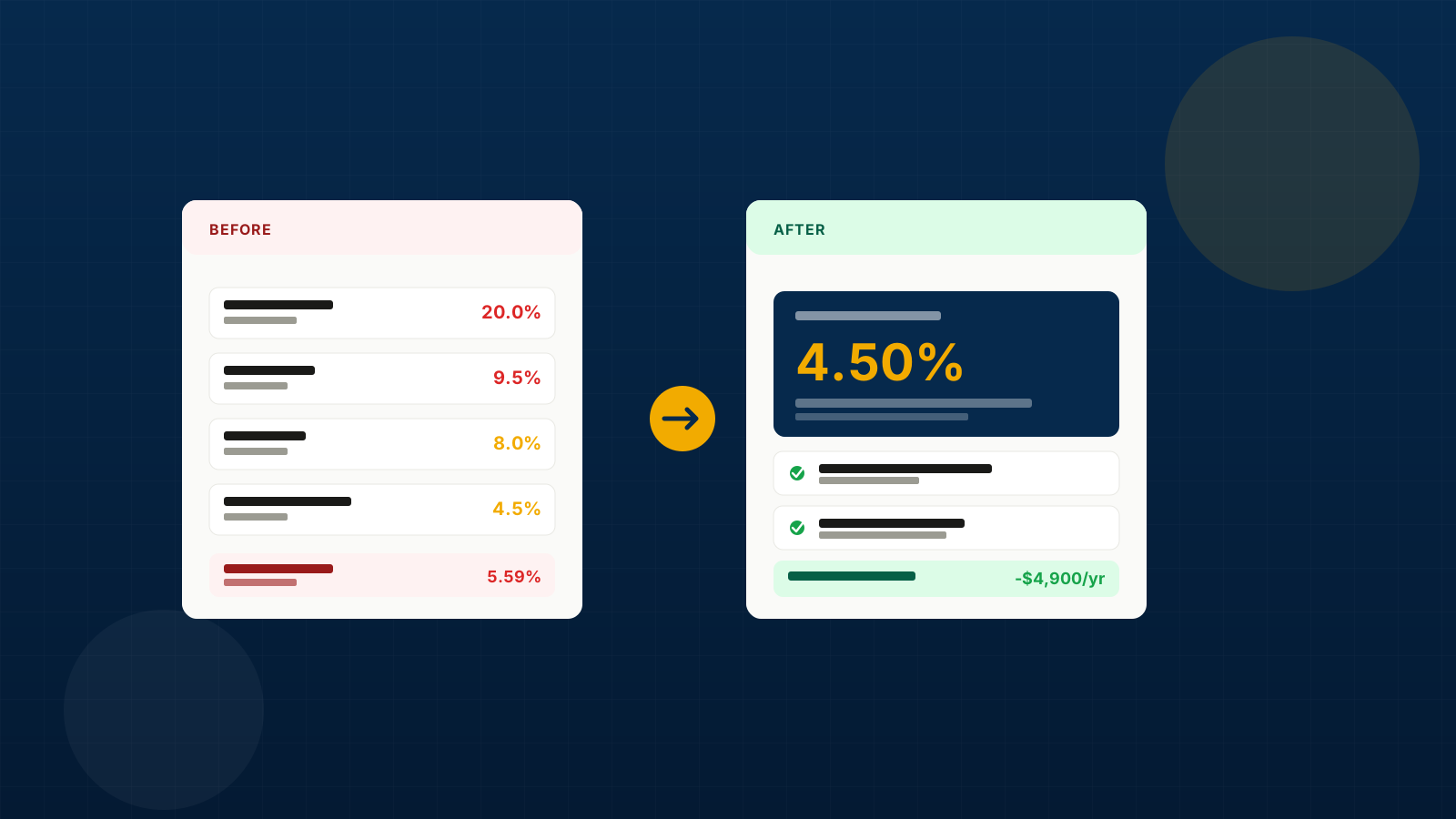
Any refinance candidate could also be a debt consolidation candidate if they’re carrying high-interest debt. A client with $30,000 on credit cards at 20 percent and $20,000 in car debt at 8 percent unlocks $5,000+ of additional annual savings by consolidating, which often turns a marginal refinance into a clear one.
Run the consolidation scenario on every refinance, HELOC, and reverse mortgage candidate. It changes the math often enough that skipping it leaves money on the table.
Identifying renewal candidates
Renewal tracking is the most basic form of book mining, and the one brokers get wrong most often. The mistake isn’t missing the renewal date - it’s contacting the client too late.
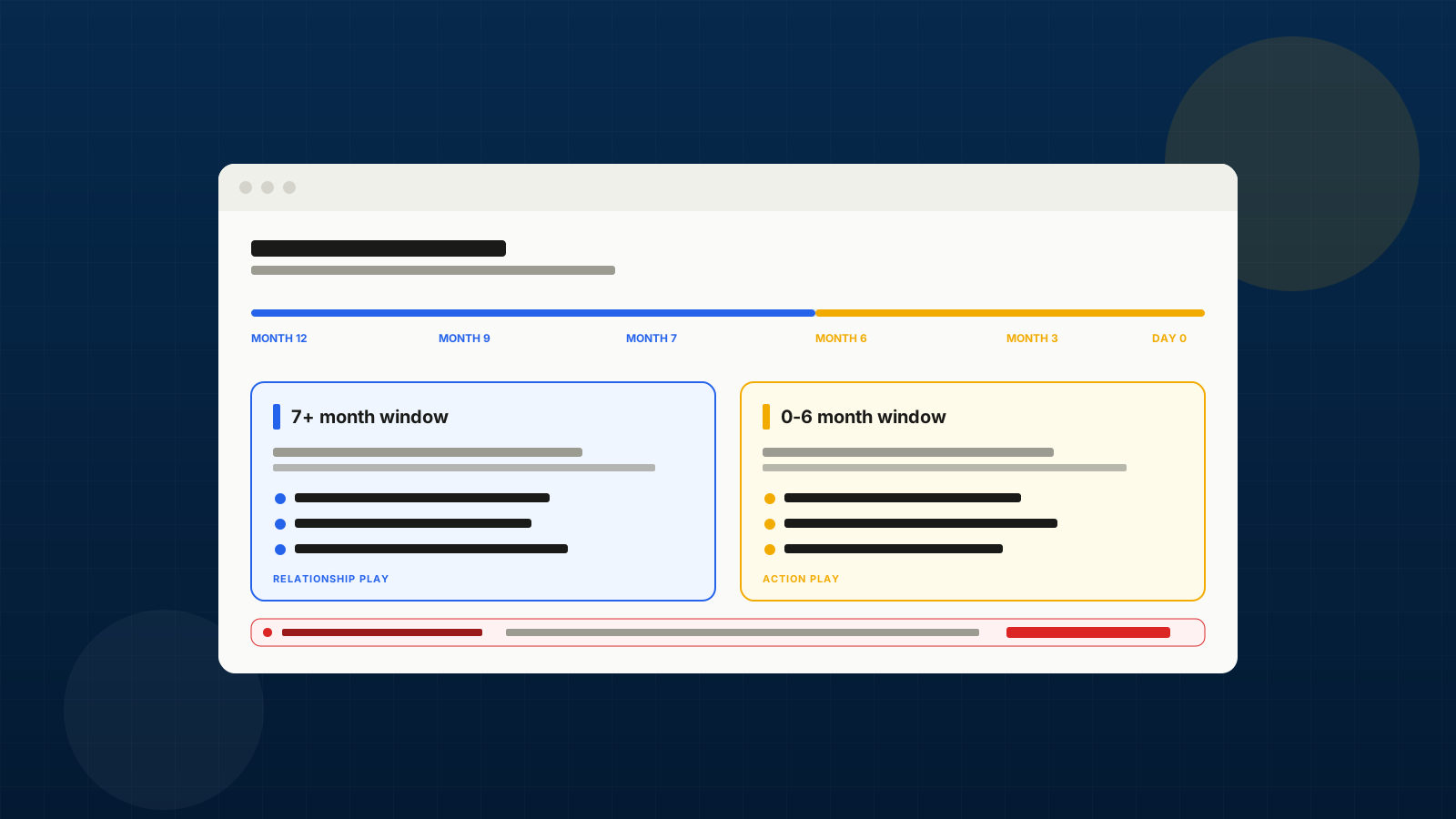
The two renewal windows
Zero to six months out. These clients are inside the standard lender renewal letter window. The bank is about to reach out with an offer - probably a posted rate that’s not their best. Your opportunity is to get in first. If you wait until they’ve signed a renewal offer, you’ve lost.
Seven-plus months out. These clients are approaching the window. This is where you build relationship without urgency. Educate them on the market, remind them a broker shops across dozens of lenders, pre-collect updated information. The broker who has the conversation at month nine usually wins the renewal the client wouldn’t have given you at month two.
The monthly maturity email
Set up a monthly internal reminder of every client whose maturity is in the next 90 days. Basic hygiene. Most brokers know they should. Few do it consistently. The ones who do have measurably better renewal retention than the ones who don’t.
If your first touch on a renewal is after the bank’s letter arrived, you’re behind. The letter triggers a retention call from the bank. The client now has one offer in hand and a rep pitching them. You’re the second conversation, which is a harder sell than being the first.
Identifying HELOC candidates
A client qualifies for a HELOC when the difference between their home’s current value and their current mortgage balance is large enough to support one:
Available HELOC = (Home value × 0.65) - Current mortgage balance
The 65 percent is the typical maximum combined loan-to-value for a HELOC in Canada. Some lenders go higher, some require lower for investment properties, but 65 percent is a reasonable default.
65%
the typical maximum combined loan-to-value for a HELOC in Canada. Multiply home value by this, subtract outstanding balance, and you have the HELOC ceiling.
Two inputs you need:
Current home value. The value in your database is what the client’s home was worth when they last transacted with you, possibly years ago. Markets move. A $600,000 home from 2020 might be $900,000 today, changing HELOC eligibility completely. Either rely on client self-reporting or use an AVM service to update the database.
Current mortgage balance. Similarly a moving target. Unless you have live lender data, you’re working off an amortization schedule applied to the original balance.
A client becomes a HELOC candidate when available HELOC exceeds some threshold - typically $50,000 to $100,000, below which setup friction outweighs the use case.
Identifying reverse mortgage candidates
Reverse mortgages apply to a narrower slice. Qualification rules for the two major Canadian providers (HomeEquity Bank’s CHIP and Equitable Bank’s reverse mortgage) are broadly:
- Homeowner at least 55 (some products 60+).
- Primary residence.
- Significant equity, typically 50 percent or more of home value.
- Property meets lender’s appraisal criteria.
The simplest filter for your book is age plus equity. Clients 55+ with 50 percent+ equity are your candidate pool. Not all will be interested and not all will qualify, but that’s the list.
Reverse mortgages are more of a conversation than a transaction. Specialized product, cautious client base, long sales cycle. But commission per deal is substantial and brokers who proactively identify eligible clients convert meaningfully better than those who wait to be asked.
The manual version
If running this manually:
- Export your client database.
- Add columns for current home value estimate, current balance estimate, remaining term in months, original contract rate, original discount, lender, client age.
- Build formulas for each category: refinance (compare rates, calculate IRD per lender, calculate net savings); renewal (flag maturity 0-6 and 7-12 months out); HELOC (calculate available equity at 65 percent); reverse mortgage (age 55+, equity 50 percent+); debt consolidation (overlay).
- Rank candidates by dollar value.
- Work the top 10 to 20 this month. Pipeline the rest.
- Update quarterly.
This works. It’s also tedious, the per-lender IRD formulas are the hardest part to get right, and the spreadsheet breaks down past a few hundred clients.
The software version
BrokerPlus imports from Filogix, Velocity, Finmo, or CSV. The platform scans the full book and ranks every opportunity across all five categories. Refinance opportunities are flagged with lender-specific IRD penalty calculations. Renewals are split into the two windows. HELOC and reverse mortgage candidates are flagged on equity estimates. Debt consolidation scenarios overlay where client debt data is available.
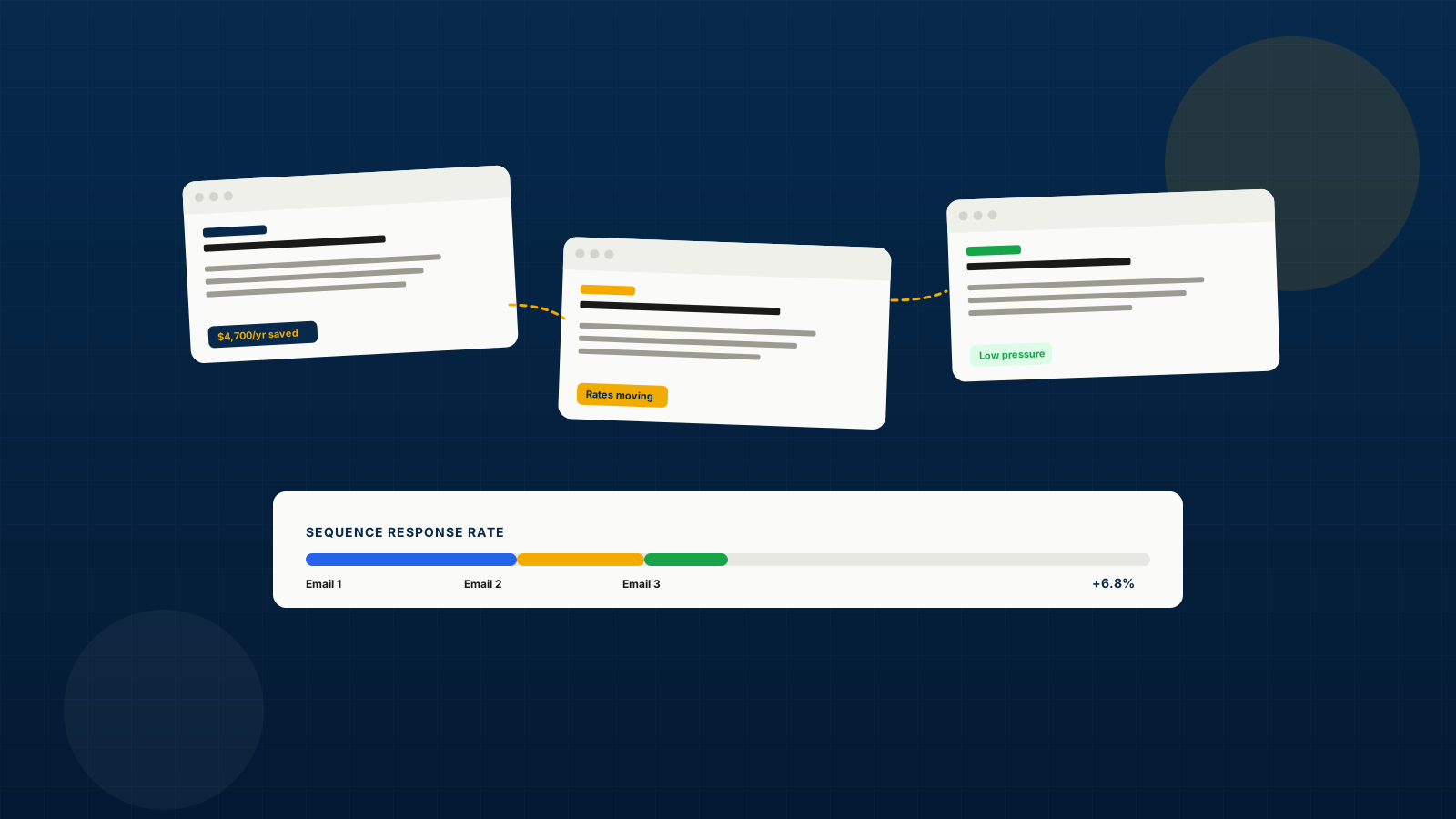
The platform updates continuously as data changes, so clients who become eligible as markets move get flagged automatically. The automated outreach layer is built in, pushing messages from your own email to your top candidates on a customizable cadence. BrokerPlus never appears in the client communication - the client sees your brand.
This is what we mean when we call BrokerPlus a revenue finder rather than a CRM. A CRM helps you manage opportunities you already know about. BrokerPlus surfaces the ones you don’t.
Frequently asked questions
What percentage of a typical book will be an active opportunity at any given time?
Our benchmark from brokerages using BrokerPlus today is roughly 15 to 25 percent of the book will have at least one actionable opportunity at any given time, depending on book age and composition. Books heavily weighted toward clients who funded 3+ years ago produce the highest opportunity density because those clients are more likely to be in or approaching a renewal window and to have accumulated equity.
How often should I re-run this analysis?
Continuously if you can, quarterly at minimum. Rates move, home values move, client financial situations move. A client who wasn’t a refinance candidate three months ago might be one today. The brokers who get the most out of book mining treat it as an ongoing process rather than a one-time project.
Do I need the client to provide updated information for this to work?
Not for the initial scan. You can run refinance, renewal, and basic HELOC analysis from data already in your origination system plus current market rates. Accuracy improves when clients update their information, most importantly current home value and any new debt. Interactive client reports that let the homeowner update their own data are the most efficient way to keep the database current.
What’s the difference between running this manually vs. buying software?
The math doesn’t change. Software does three things manual work doesn’t: runs lender-specific IRD formulas rather than generic ones, updates continuously rather than when you remember to re-run the spreadsheet, and automates the outreach so the opportunity becomes a client conversation rather than a number on your screen. For a broker with under 100 clients, the manual version is probably adequate. Beyond that, software starts paying for itself quickly.
How do I prioritize which opportunities to work first?
Rank by total dollar value of the opportunity to you, not to the client. A $600,000 refinance at 1.5 percent commission is worth more than a $100,000 HELOC, even if both help the client meaningfully. Work the big numbers first. Don’t neglect the renewal window entirely - a renewal you miss because you were working refinances is a client you’ve just handed to the bank.
What if my database is messy or incomplete?
Every broker’s database is messy. The opportunity finder still works; it flags records it can’t fully analyze rather than producing garbage output. For incomplete records, the system (or you) can either skip them, fill them in using AVM data and amortization calculations, or send the client an interactive report that asks them to update their own information.
How does this interact with my existing CRM?
It sits alongside, not on top of. Your CRM manages active deals and team pipeline. The revenue finder mines past clients for future deals. Different jobs. Most brokers using BrokerPlus keep their existing CRM (usually BluMortgage, Velocity, or whatever their network provides) and use BrokerPlus specifically for the book mining and compliance layer.