Canadian home values moved dramatically between 2020 and 2024. The average detached home in many markets gained hundreds of thousands of dollars. Clients who couldn’t qualify for a HELOC five years ago qualify easily today. Clients who were too young for a reverse mortgage in 2018 are in the eligible window now.
And most Canadian mortgage brokers can’t see any of this, because their client databases still show 2020 home values and 2020 mortgage balances. The opportunity is real; the visibility isn’t.
This post is the tactical playbook for changing that. How to identify HELOC candidates systematically. How to identify reverse mortgage candidates systematically. What data you need, where to get it, and how to triage once you have the list. Written for Canadian brokers working with the specific Canadian products (not US HELOCs, not US reverse mortgages, which have different rules).
Why this matters now
Three things converged to make equity-based opportunities high-value in 2026:
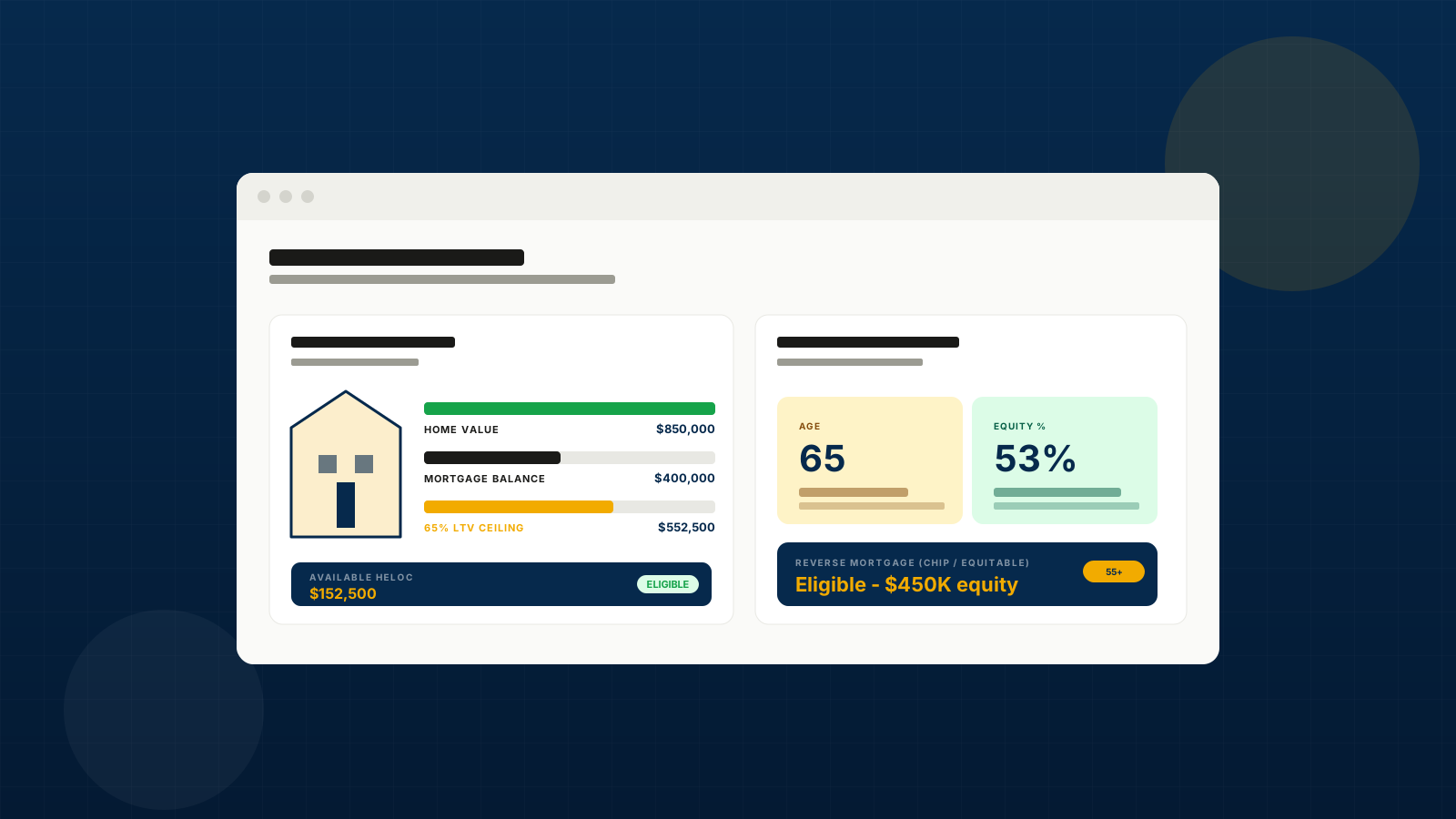
Appreciation created new eligibility. A client whose home was $600K with a $450K mortgage in 2020 had $150K of equity - tight for HELOC purposes and nowhere near reverse mortgage territory. The same client today might have $850K of value against a $400K balance. That’s $450K of equity and clear HELOC eligibility, potentially clear reverse mortgage eligibility depending on age.
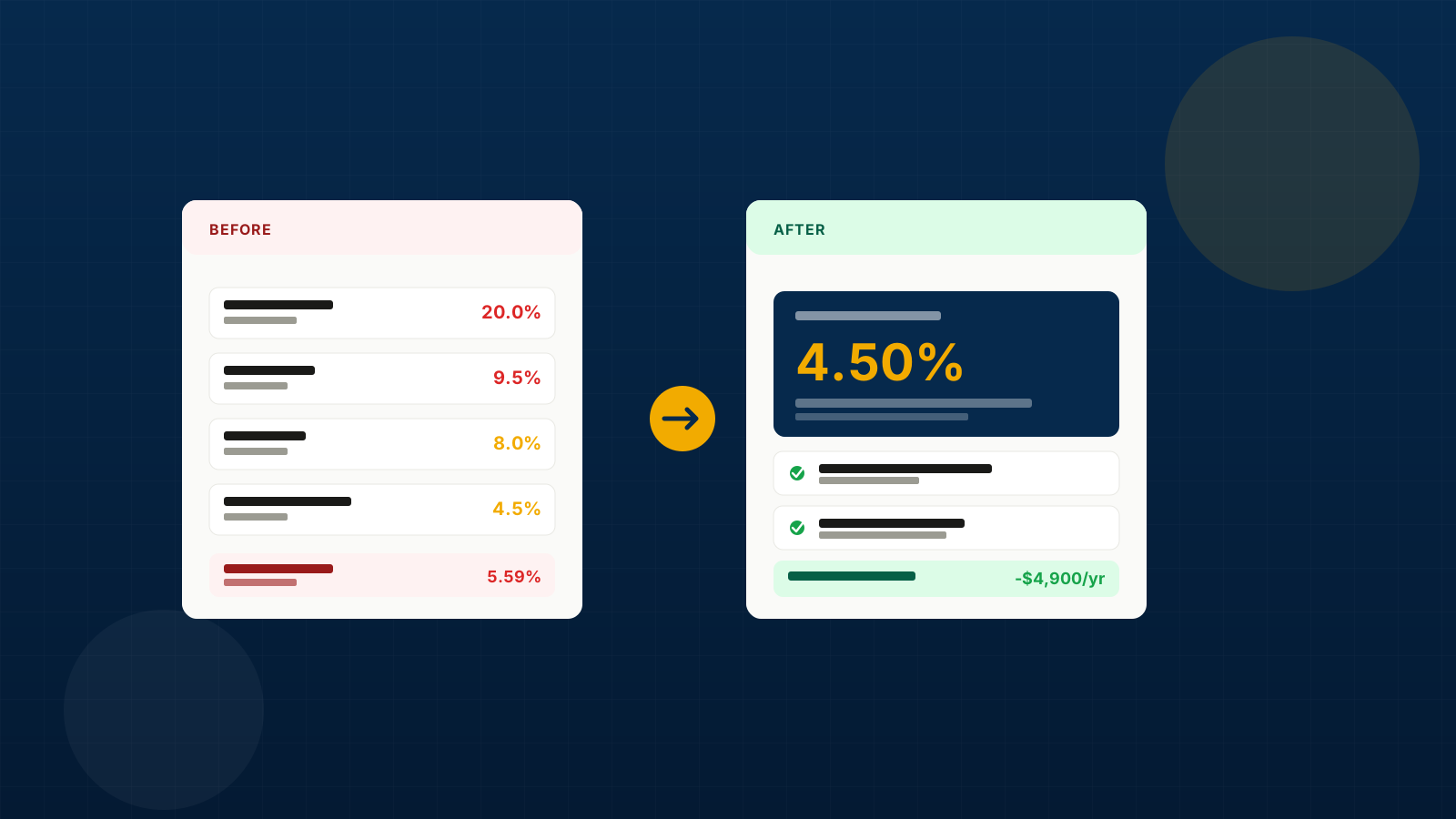
Interest rate spreads made equity products competitive. HELOCs at prime plus a margin are competitive against unsecured debt at 20 percent or against tapping registered accounts. The math for consolidation, renovation, or investment use cases now favours equity takeout more than it did in flat-rate environments.
The aging population increased reverse mortgage relevance. The cohort of Canadian homeowners aged 55-70 is the largest it’s ever been, and the fastest-growing segment of eligible reverse mortgage candidates. The product is moving from niche to mainstream.
The broker who has systematic visibility into their book captures these opportunities. The broker who doesn’t gives them to the bank.
Identifying HELOC candidates
The HELOC question is fundamentally an equity math question. Once you know the client’s current home value and current mortgage balance, you know whether they qualify.
The formula
Available HELOC = (Home value × 0.65) - Current mortgage balance
The 65 percent is the typical maximum combined loan-to-value for a HELOC in Canada. Your first mortgage plus the HELOC can’t exceed 65 percent of the home’s value in most cases. Some lenders go higher for certain clients; some require lower for investment properties or non-prime applicants. 65 percent is the right default for triage.
65%
the typical maximum combined loan-to-value for a HELOC in Canada. Multiply home value by this, subtract outstanding balance, and you have the HELOC ceiling for that client.
What counts as a qualifying HELOC candidate
A client crosses into “worth calling about a HELOC” when the available HELOC exceeds a threshold you care about. Most Canadian brokers use $50,000 to $100,000 as the minimum worth the client’s setup effort.
Below $50K, the HELOC is mostly useful for small emergency access and the setup friction outweighs the use case for many clients. Above $100K, the HELOC starts being meaningful for real financial planning (renovation, investment, consolidation).
So the filter is: which clients in my book have (Home value × 0.65) - Current mortgage balance > $50,000?
The two inputs you need
Current home value. The hard part. Every broker’s database is out of date. You need a reliable way to update property values without a manual appraisal per client.
Options:
- Automated valuation model (AVM). Houski is the most common Canadian broker option. Opta and Purview are alternatives. Run your book through an AVM to get current estimates.
- Client self-report via interactive client reports. Some tools (BrokerPlus, Ownwell) send clients a branded report where they can confirm or update their own home value. Self-reporting isn’t perfectly accurate but it’s often more current than the database.
- Manual lookup. Works for small books. Doesn’t scale past 50 clients.
Current mortgage balance. Slightly easier. If you don’t have live lender data, calculate from the original commitment: original balance, amortization schedule, time elapsed, any prepayments. The result is a reasonable estimate even if not perfectly accurate.
If you have the client’s most recent NOA or statement, even better. FastKey and similar Canadian broker tools can pull these. Otherwise calculated amortization.
The triage process
Once you have the two inputs across your book:
- Calculate available HELOC for every client.
- Filter to clients where available HELOC > $50K.
- Rank by dollar value of available HELOC.
- Look at the top 20 candidates and assess: do any have known life situations that suggest they’d use this? (Renovation conversations, tuition costs, investment interest, reported debt from credit check.)
- Start outreach with the top candidates where the use case is most obvious.
What to say to a HELOC candidate
The conversation isn’t “you qualify for a HELOC, here’s the application.” It’s about the client’s financial goals and how the HELOC could support them.
Example framing: “I was reviewing your file and noticed your home value has grown meaningfully since we last connected. If you ever have renovation plans, investment opportunities, or are thinking about consolidating higher-interest debt, you’d have access to significant equity through a HELOC. Want to talk through what’s possible?”
Non-pushy, client-focused. The HELOC is an option you’re making them aware of. The client decides whether the option fits their situation.
Identifying reverse mortgage candidates
Reverse mortgages apply to a narrower slice of the book but the deal size and commission are substantial, which makes systematic identification worth doing even when the candidate pool is smaller.
Canadian reverse mortgage products
The two major providers in Canada:
HomeEquity Bank (CHIP program). Age 55+, primary residence, significant equity. The CHIP Reverse Mortgage and CHIP Max are the main products. Minimum property value requirements vary by market.
Equitable Bank (Reverse Mortgage product). Age 55+, primary residence, similar equity thresholds. Competitive pricing against HomeEquity’s CHIP in many markets.
Both products share the core structure: the homeowner borrows against home equity without monthly payments. Interest accrues and the loan is repaid when the home is sold, the owner moves, or on death.
Qualification filters
Your book filter is age plus equity:
Reverse mortgage candidate = Age 55+ AND Home value × (1 - current mortgage/home value) > ~50%
In English: client is 55+ and their current equity position is at least 50 percent of their home’s value. These are broadly the minimums; specific lenders go higher in some cases.
Some nuance:
- Age 60+ qualifies more easily. At 55-59, the loan-to-value available is lower; at 60+, it scales up; at 70+, it scales higher still.
- Property type matters. Freehold detached homes qualify easily; condos have additional requirements; mobile homes often don’t qualify.
- Primary residence is mandatory. Investment properties and vacation homes don’t qualify for either product.
- Appraisal requirements. Both products require a professional appraisal, so your AVM estimate is a filter for triage, not a qualification guarantee.
The triage process
- Filter your book to clients 55+ (age data from your origination records).
- For those clients, calculate current equity position using current home value estimate and current mortgage balance.
- Flag clients with 50 percent+ equity as candidates.
- Further filter for freehold detached (easiest to qualify) as the starting pool for outreach.
- Rank by available equity dollar amount.
The candidate pool for most Canadian brokers is smaller than the HELOC pool but the average deal size is substantially larger, so the dollar-value-ranking of candidates often looks similar.
What to say to a reverse mortgage candidate
Reverse mortgages are a longer sales conversation than HELOCs. Many clients have preconceptions, some negative. Your opening isn’t “you qualify for a reverse mortgage” - it’s often “I’ve been reviewing my clients’ situations and wanted to make sure you know what options you have around your home equity.”
The reverse mortgage pitch typically works best for specific use cases:
- Retirement income supplementation. Client has pension and RRSP income but wants more cash flow.
- Major expenses. Home renovations, healthcare costs, supporting adult children or grandchildren.
- Eliminating the current mortgage. Some 55-65 year old clients still have a small remaining mortgage they’d like to eliminate in retirement.
- Staying in the home longer. Client and partner want to stay in their home rather than downsize; reverse mortgage funds the staying.
Don’t pitch reverse mortgages as “free money” - they’re not, the interest accrues - but as a financial tool that fits specific situations.
The long sales cycle
Reverse mortgages are sold, not bought. The typical sales cycle from initial conversation to closing is 60 to 120 days. Many clients want to consult with adult children, their accountant, sometimes their financial advisor. Be patient.
How software systematizes this
The manual version works for small books. At scale, you need a revenue intelligence platform that handles both the HELOC and reverse mortgage identification automatically.
BrokerPlus scans your book on import and continuously after. For every client:
- Calculates available HELOC based on current home value estimate and current mortgage balance.
- Flags reverse mortgage candidates based on age and equity filters.
- Overlays debt consolidation scenarios (covered in the next post) on both categories where relevant.
- Ranks candidates by available dollar value.
- Updates as property values and balances change.
Houski AVM integration provides current home value estimates without manual lookup. Interactive branded reports let clients self-update their property data when it changes. The combination produces a live candidate list across your book rather than a one-time analysis.
For brokerages with multiple agents, the platform produces the same view at brokerage level - principal brokers can see HELOC and reverse mortgage opportunities across the full firm, which is operationally useful for identifying which agents have the densest opportunity books.
Frequently asked questions
What percentage of my book will be a HELOC candidate?
Our benchmark across Canadian brokerages is 15-25 percent of books will have at least one HELOC candidate at any given time, assuming a modest $50K minimum threshold. Books weighted toward clients who funded 3+ years ago in appreciating markets produce the highest candidate density.
What percentage will be reverse mortgage candidates?
Smaller - typically 5-12 percent depending on book composition. Books weighted toward older clients (55+) produce more candidates; books weighted toward first-time buyers and younger demographics produce fewer.
Do I need to update home values before the scan works?
Helpful but not strictly required. A scan run on out-of-date values will underestimate HELOC availability (because your database shows a lower home value than today’s reality). Updating with an AVM like Houski surfaces additional candidates that wouldn’t have appeared otherwise. For reverse mortgage triage, current values matter less because the filter is proportional equity rather than absolute.
What if a client has both a HELOC opportunity and a reverse mortgage opportunity?
They often do. Clients 55+ with significant equity frequently qualify for both. The choice depends on the client’s situation: HELOC for active use of equity with repayment expected, reverse mortgage for ongoing supplemental income without repayment during the client’s lifetime. Present both options when both apply; let the client and their other advisors help them choose.
How do I handle the long sales cycle on reverse mortgages without losing momentum?
Set the initial conversation, provide clear written materials, and follow up at regular intervals (every 2-3 weeks) rather than badgering. Many reverse mortgage clients are consulting with family and other advisors; your job is to remain present and useful without applying pressure. A revenue intelligence platform that handles automated outreach can manage the follow-up cadence without requiring the broker to remember every touch.
Can I send HELOC and reverse mortgage offers to my whole book?
No. The personalization of “you specifically have $X of available equity, here’s how it could work for your situation” is what drives engagement. Generic HELOC marketing to your full book lowers your response rate and trains clients to ignore your emails. Ranked, personalized outreach to specific candidates with specific amounts works.
What about commercial or investment property equity?
Different products, different rules, different qualification. HELOCs on investment properties have lower max LTV (often 50 percent rather than 65 percent). Reverse mortgages don’t apply to investment properties at all. If a meaningful part of your book is investment property, triage those separately with product-specific filters.